


JustMoney’s second annual Money & Me survey, conducted in July and August 2026, attracted more than 5,400 respondents. A year on, the results show a population under growing financial pressure, as assessed across six broad categories: earning, borrowing, spending, saving, protecting, and trusting.
Earning
Just over half of the respondents (52%) take home more than R10,000 a month; but that income is being stretched further than it was a year ago. More respondents are leaning on a single salary to support their households.
Monthly hardship and family pressures have grown
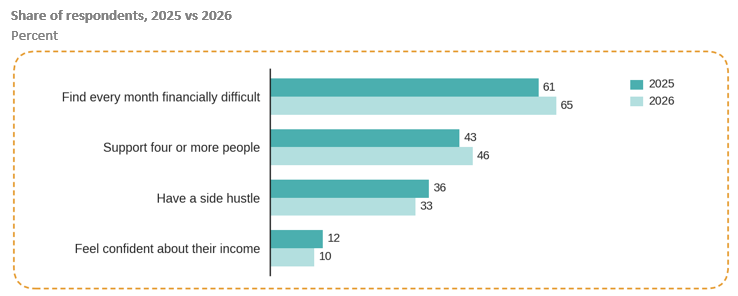
Monthly hardship is rising: 65% find every single month financially difficult, up from 61% in 2025. Among the lowest earners (under R5,000), this rises to 72%. January and December are the toughest months.
Support burden grows: 46% support four or more people with their income, up from 43%. This burden is heaviest for those aged 35–55 (the sandwich generation).
Income confidence gap: Only 10% feel confident about their income, while 39% are worried. Women remain less confident than men (8% vs 14%). Those taking home R5,000 – R10,000 saw the sharpest decline: 68% now feel worried or nervous about their income, up from 59%.
Gender earnings gap: 49% of women take home more than R10,000 a month, compared with 55% of men. The gap widens with age: Among 35 – 44-year-olds, 53% of women take home more than R10,000 a month, compared with 60% of men.
Extra income is sought, but side hustle startups are challenging: 33% have a side hustle, slightly down from 2025 (36%). The most common pursuit is buying and selling online. Of those without a side hustle, about 70% want to earn additional income but don't know how to start.
Borrowing
Debt pressure has risen sharply in the past year; more than half of respondents (51%) are now in unsustainable territory, up from 38% last year.
Debt pressure is up; over-35s carry the heaviest load
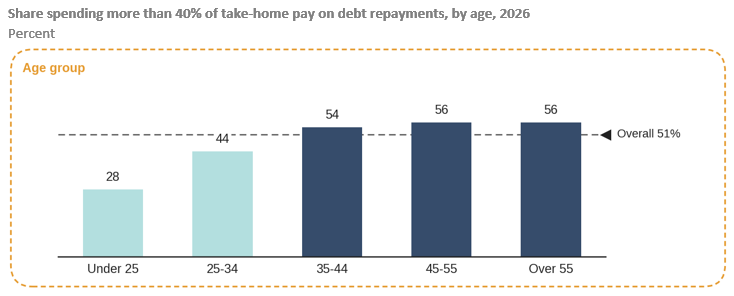
Unsustainable debt levels: 51% spend more than 40% of their take-home pay on debt repayments, up markedly from 38% in 2025. A further 7% don't know how much of their income goes to debt.
Debt pressure more acute in some groups: Debt stress is most acute among those aged 35 or older and those taking home R10,000 – R20,000 a month.
Borrowing blind: 37% don't know the interest rate on their largest loan; this rises to 43% among those taking home less than R5,000. Some 87% don't review the cost of credit insurance, even though this can make up ~15% of the repayment amount.
Gendered borrowing preferences: Women prefer to borrow from family or friends (49% vs 40% of men), while men are more comfortable approaching formal lenders such as banks and financial services companies (63% vs 53% of women). Men are also 9% more likely to check a loan's terms and conditions. These trends were also evident last year.
Mashonisas gaining ground: Willingness to borrow from a mashonisa (informal lender) has risen for both women (20% to 24%) and men (21% to 23%). People are also increasingly reluctant to approach their employers for a loan.
Spending
Stretching money is top of mind for everyone, and the move away from cash is gaining momentum.
Prioritising basics: If given R1,000, 69% would spend it on groceries – 73% of women and 65% of men. Among the lowest earners, 76% would buy groceries, compared with 48% of the highest earners.
Specials drive shopping: 69% choose where to shop based on the specials on offer. Most believe physical shops are cheaper than online, though younger and higher-earning respondents are less likely to agree.
Gambling is widespread: 54% spend money on gambling or the lotto regularly, though amounts are generally small (an estimated average of under R200 a month). Those taking home less than R5,000 are three times more likely to stretch their money with an online betting app than by looking for restaurant deals.
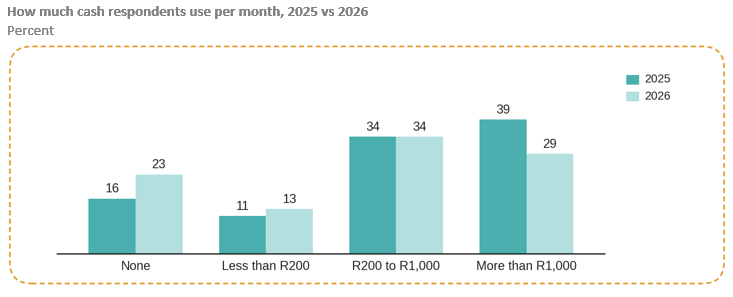
Cash is no longer king: 23% don't use cash at all, up from 16% in 2025, while the share using more than R1,000 in cash per month fell from 39% to 29%.
Cash is retreating: 23% now use none at all
Saving
Little is left over at month-end, and, concerningly, retirement savings are increasingly being used to plug the gap.
Saving and borrowing: 43% need to borrow money before month-end, up from 42% in 2025. Those supporting four or more family members have only a 7% likelihood of saving 10% or more of their income each month.
Retirement gaps: 32% do not have a retirement annuity (RA). This rises to 53% of under-25s and 56% of those taking home less than R5,000. Women (36%) are more likely than men (27%) to be without an RA, highlighting their future vulnerability.
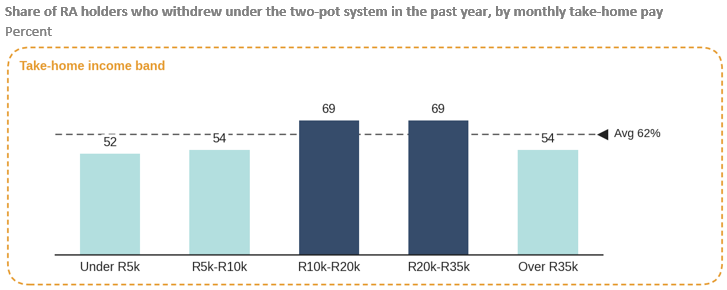
Two-pot as a cash flow tool: 62% of those with an RA withdrew money under the two-pot system in the past year. This rises to 69–71% among those aged 35–55. The largest share of withdrawals was for less than R5,000, suggesting many use the system to manage cash flow, which is not its intended purpose.
A broke retiree time bomb: Combined with those who have no RA at all, these withdrawals suggest many South Africans have a mountain to climb in retirement.
More than half of RA holders dipped into their two-pot savings
Protecting
Most South Africans have little cushion against a financial shock, and insurance cover is closely tied to income.
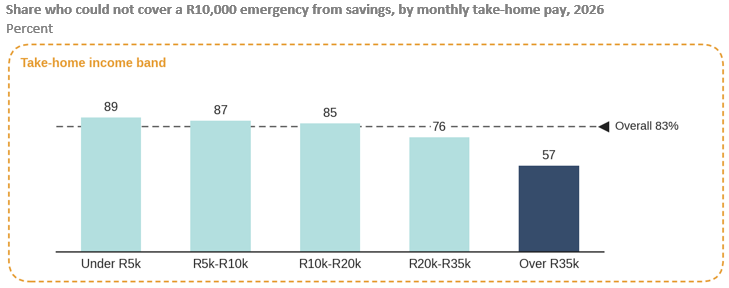
Emergency fund deficit: Only 17% could cover a R10,000 emergency from savings. Women are more exposed than men (87% vs 78% could not cover this amount).
Funeral cover dominates: Funeral cover is the most popular insurance, with 67% of respondents holding at least one policy. 41% pay for two or more funeral policies, mostly to cover other family members – yet several small policies are usually more expensive than one larger policy.
Cover follows income: The highest earners are three times as likely to be insured as the lowest earners. Asset cover (house, contents, vehicle), medical cover, and income protection all rise with income.
Priorities reveal daily realities: Cell phone cover is held by twice as many people as household contents or building cover, while men are twice as likely as women to have legal insurance (12% vs 7%).
Even among the highest earners, 57% could not cover a R10,000 emergency
Trusting
South Africans say they trust financial institutions, not celebrities – yet scams remain widespread, and social media is the main mechanism.
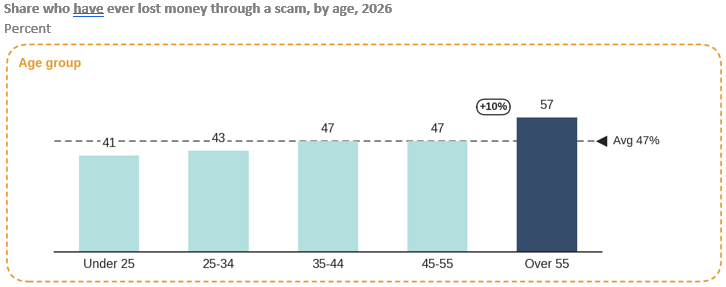
Scams are prevalent: 47% of respondents have lost money to a scam; most amounts are less than R5,000.
Biggest threat: A social media post is by far the most common scam method (22%), followed by friends, colleagues, or family members (12%) and cryptocurrency schemes (10%).
The advice paradox: More than 70% say they would take financial advice from an adviser or bank, and only about 4% from a celebrity or influencer, yet close to half have lost money to a scam.
Older people are most at risk: Over-55s trust the least, yet 57% have been scammed – 10% above the average. They also lose larger amounts – 17% of scam victims aged over 55 lost more than R50,000.
Cryptocurrency. Only 13% have invested in cryptocurrency. The main barrier is comprehension: 47% of non-investors say they don't understand it.
Over-55s are the most likely to have lost money to a scam
From surviving to having choices
Psychologist Andrea Kellerman says chronic financial pressure pushes people into survival mode, narrowing long-term choices and making immediate coping strategies – such as informal borrowing or using retirement savings – more likely. Although financial confidence and competence are distinct, people need credible pathways, practical tools, and sufficient safety, confidence, and emotional capacity to strengthen their financial agency and make better decisions.
Kellerman stresses that women's lower financial confidence should not be read as lower capability. Confidence and competence are different – the gap is one of financial agency, not knowledge. Similarly, the many people who want a side hustle but don't know where to start are not lacking motivation, but a believable pathway.
Kellerman makes the following recommendations:
Make debt feel real. Help people understand interest rates, percentages, and the true cost of borrowing, not just the monthly instalment. Show practical ways to assess debt, reduce repayments, and recognise when borrowing has become unsustainable.
Build emotional intelligence for money. Debt isn't just about money. Teach practical skills such as recognising emotional triggers, managing anxiety, delaying impulses, challenging shame, communicating about money, setting boundaries, and thinking beyond the immediate crisis.
Build financial confidence and agency. For women in particular, move beyond financial knowledge to the confidence to ask, negotiate, compare, and decide. Small, achievable actions can rebuild self-efficacy, control, and hope.
Create ways to cope without sacrificing tomorrow. When money runs out, people need real alternatives to expensive borrowing or dipping into retirement savings. Teach ways to prioritise essential payments, restructure debt, access support, and distinguish an emergency from an ongoing cash-flow problem.
Turn financial stress into action. People often want to change their situation but don't know where to start. Give them one clear next step – whether managing debt, creating additional income, protecting themselves from scams, or making digital spending visible – to replace overwhelm with action and restore a sense of agency.
Meet people where they are. Take money and mindset education to accessible platforms such as social media, using short videos, reels, and story clips that explain how stress, scarcity, and emotion affect money decisions – and show people how to pause, regulate, and think more clearly.
The aim, Kellerman concludes, is to help South Africans find a safer way through today without continually borrowing from tomorrow.